
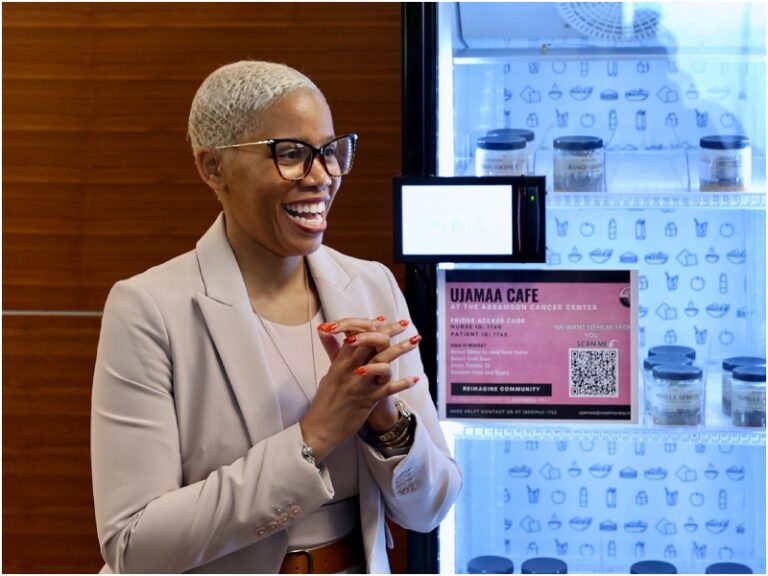
Like many Black women, Dr. Leeja Carter believed that excelling in academia would bring her success, accolades, and purpose. So, for nearly 15 years, Dr. Carter rose through the ranks. A tenured professor with a PhD in kinesiology, a master’s in forensic psychology, a Fulbright scholarship to London, and a published book on feminist applied sports psychology, she had achieved every traditional metric of professional success.
Yet, while she spent years in classrooms, conferences, and meetings surrounded by intellectuals and peers, she felt isolated.
“My experience inside of the academy as a Black woman researching Black women’s health experiences… I felt targeted. I didn’t feel supported in that work,” Dr. Carter reflects.
Bubbling up inside of her was a desire to take her work out of textbooks and classrooms to directly impact the community. In October 2021, the dream that lay dormant in her heart and mind finally rose to the surface, and with one letter of resignation, she stepped down from her academic pedestal to dedicate herself full-time to founding the Coalition for Food and Health Equity.
From zero experience running a nonprofit to delivering fresh, high-quality food to underserved communities, here is how Dr. Carter is proving that when you trust your purpose and step outside traditional lines, you can truly make an impact.
Walking into Faith and Ancestral Trust
Growing up in a household where pursuing higher education wasn’t just an option but an expectation, Dr. Carter saw any other path as defiance.
“Going to college, my father was like, ‘Hey, you’re going to school, you’re going to be a doctor or a lawyer.’ It was already implanted in me,” Dr. Carter shares. “For me to step outside of that was like a sin.”
Given family expectations and her background in analytical environments, you might assume her decision to start a new career was calculated and strategic. Surprisingly, what made her take the leap was a profound spiritual moment.
Not to quote Martin Luther King Jr., but Dr. Carter had a dream as well, one where she felt guided by God and her ancestors telling her: Everything is going to be alright; surrender to the purpose that’s in front of you.
Leaning 100 percent on faith, she took a chance on herself.
“One of the most powerful things that we as Black women have is this deep ancestral, spiritual connection of trust,” she says. “If we can connect to that, then there’s so much power that we have. It’s a healing journey of healing some of these inner child wounds of thinking that our path has to be very sterile, very defined, very one note—and understanding that our path may be very divergent, very colorful, very fantastical.”
With four degrees, unyielding faith, and strong community support, she traded university lecture halls for grassroots organizing.
Innovation Driven by Human Dignity: The Ujamaa Cafe Model
Dr. Carter started the Coalition for Food and Health Equity not only to fight food insecurity in food deserts across New Jersey and Philadelphia, but to remind the most vulnerable communities that they are worthy of respect and quality food.
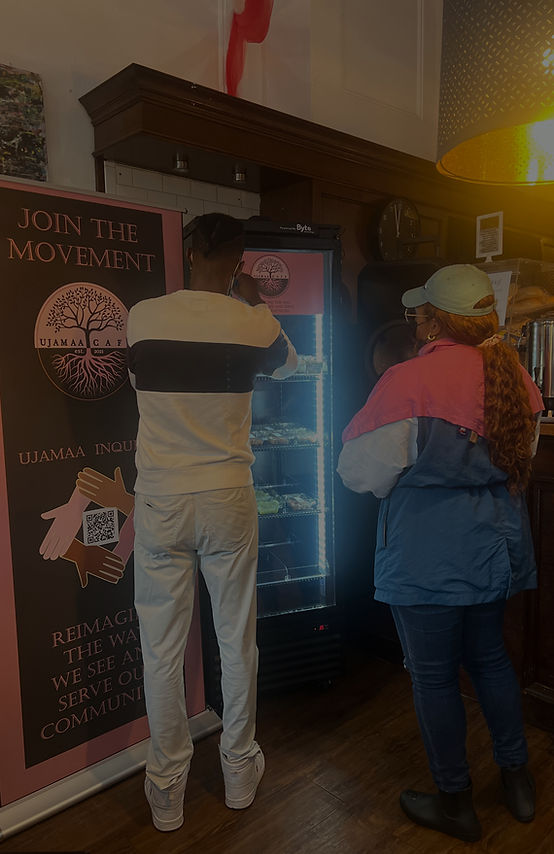
From this mission, the Ujamaa Cafe model was born. The Coalition deploys smart, technology-enabled refrigerated hubs placed strategically in schools, cancer centers, rec centers, and food pantries throughout food-apartheid neighborhoods.
How the Smart Fridges Work
Gone are the days of outreach passing out dry sandwiches, juices, and day-old restaurant leftovers. The Coalition purchases fresh meals, salads, juices, and parfaits directly from local cafes, restaurants, and food trucks. Think shrimp burritos.
This model not only reinvests in local small-business economies; it also honors individuals who have unique dietary needs, preferences, and allergies.
“Whether someone is pescatarian, vegetarian, vegan, or has allergen sensitivities, let’s have it all up in there. There is freedom and choice. We don’t have to ask questions. Based on their choice information, we restock.”
Restocking isn’t simply a routine procedure; it’s a system backed by science and intention. Using an RFID tracking system, internal sensors notify the team in real time as items are selected by community members.
The Coalition receives data every time someone takes an item, communicating which options are popular and which are less desired. With this information, refrigerators are restocked based on preference data, keeping the spoilage rate under 5%.
“If we really want to do the good work of nutrition—thinking separately from food security, but actual nutrition equity—that’s a different framework,” Dr. Carter emphasizes.
Nonprofit Success Comes from a Strong Business Strategy
From the early days of the Coalition, Dr. Carter has always focused on building a strong financial foundation. Through grassroots community efforts, the organization raised over $30,000 via a GoFundMe campaign right at the start.
Since then, Dr. Carter has focused on running the Coalition more like a structured enterprise than a standard charitable project.
“A nonprofit is a business. People don’t think of it as a business—they think of it as charity. When you do that, you don’t treat it like one, and it has to be financially stable to support the community.”
Her approach blends corporate-grade operational strategy with deep-rooted community accountability:
- Methodological Strategy: Implementations follow intentional one-to-two-year planning phases to align hub placement directly with neighborhood needs and data.
- Coalition Building: The organization fosters collaborative partnerships across local government agencies, health networks, and local restaurant owners (such as Jersey City’s Cafe Peanut).
- Decentralized Operations: Dr. Carter builds institutional operations so the mission endures independently of any single individual, creating a sustainable legacy.
The 10-Year National Horizon
Recognized as one of AfroTech’s Future 50, Dr. Carter is scaling her community-rooted model far beyond its original New Jersey footprint.
With active expansions bringing Ujamaa Cafe and Ujamaa Well to Philadelphia, Nashville, Los Angeles, and beyond, the Coalition has set a bold vision: 50 U.S. cities and 4 international markets over the next decade.
For Black women looking to break free from conventional career paths and build legacy projects, Dr. Carter’s journey serves as a powerful testament to trusting one’s vision:
“Surrender to the purpose that’s in front of you,” Dr. Carter encourages. “There’s no book on that. There’s no class on that. You just have to trust and have faith.”

