
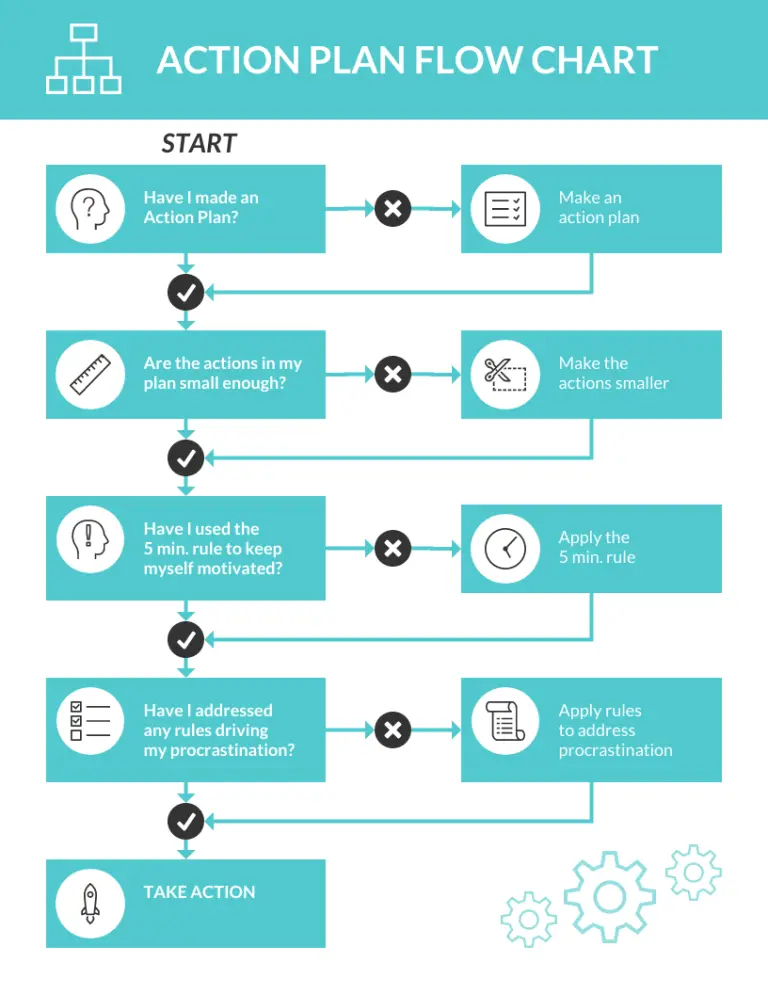
Flowcharts are an essential tool for presenting information in a form that is easy to follow. A good flowchart should include only the necessary components, be legible and easily understood. Here are 14 qualities of a good flow chart example:
1. Clear and concise process flow diagram
A good flow chart example is clear and concise, making it easy to understand. It uses simple, easy-to-read graphics and text, with no excess verbiage. The labels and titles make it easy to see what you’re looking at.
2. Accurately illustrates the process map or system being explained.
A good flow chart example will accurately illustrate how a process or system works, without omitting important steps or including unnecessary ones. It’s not enough to show the general idea; if any points may be open to interpretation, they should be clearly explained in the accompanying text (see #1 above).
3. Uses simple graphics on the flow diagram
Good flow charts use basic shapes like squares, diamonds, and circles for their symbols, rather than complicated images with multiple colors and shading effects. This makes it easier to understand what each symbol represents — a key concern in building a good chart because of how small some viewers’ screen resolutions may be.
4. Follows a logical order.
The symbols and text in a good flow chart example are arranged in a logical order so that the reader can easily follow the process being explained. This means starting with the beginning and proceeding step-by-step to the end.
5. Shows all possible paths in the flow chart template
A good flow chart example will show all possible paths through the process or system being explained. This helps identify potential problems and allows for more thorough troubleshooting.
6. Is easy to update.
Good flow charts are easy to update as new information becomes available, changes are made to the process or system they explain. All you need to do is make the appropriate changes to the underlying spreadsheet and re-create the flowchart, rather than trying to update one that’s locked into a specific template.
7. Resembles diagrams used in similar systems.
If you’re designing a flow chart example to explain how your process works, it should resemble other examples of documentation for similar processes or systems — both in style and layout. If not, users may find it more difficult to understand what they’re seeing or find themselves second-guessing whether the information presented is accurate. You might also need to use the diagram maker available on Venngage.
8. Contains an easily identifiable starting point.
A good flow chart starts with an easily identifiable starting point, whether it’s labeled “start” or includes an image symbolizing start (like a circle). This lets readers know where they are when they first start looking at the chart and makes it easier to follow the flow of information.
9. Ends with an easily identifiable ending point.
As a good starting point, a good ending point is easy to identify and lets readers know when they’ve reached the end of the flow chart. It may be labeled “end,” have an image symbolizing the end (like a diamond), or simply be the last step in the process being explained.
10. Is well-organized and easy to follow.
A good flow chart example is well-organized and easy to follow, making it an effective communication tool. The symbols are clear and concise, and the text is easy to read. The layout is simple and logical, with no excess clutter.
11. Is visually appealing.
A good flow chart is also visually appealing, with an attractive layout and well-chosen colors. This may not be as important as other factors, but it can help to make the chart more inviting to look at and easier on the eyes.
12. Is easy to print.
Good flow charts are easy to print so that you can have a hard copy for reference or to share with others. The layout is designed for easy printing, with minimal waste of paper. All necessary information is included on a single page or a few pages at most.
13. Is easy to convert to a digital format.
Good flow charts are also easy to convert to a digital format so that you can view or share them on a computer or mobile device. You can do this by saving the chart as an image (like a PNG file), inserting it into another program, adding it to your website, copying its URL, etc. As with print versions, all necessary information is included in the digital version — ideally without multiple clicks or pages of navigation.
14. Includes clear flowchart symbols.
Good flow chart examples use clear symbols that are easy to understand and accurately convey their intended meaning. Symbols like these should be used:
– Boxes: Represents object(s) or topic(s) under discussion; can also represent options for decision-making purposes; e.g., “Do you want fries with that?”
– Diamonds: Represents the end of a process or system, usually denoting “success” or “completion”
– Arrows: Used to indicate the direction of flow between boxes or steps; can also be used for emphasis
Conclusion
Good flow charts are easily recognized by the clarity of their symbols, organization, layout, and readability. Identifying these qualities in a flow chart example can help you to quickly weed out bad examples or pick one that’s right for your needs.