
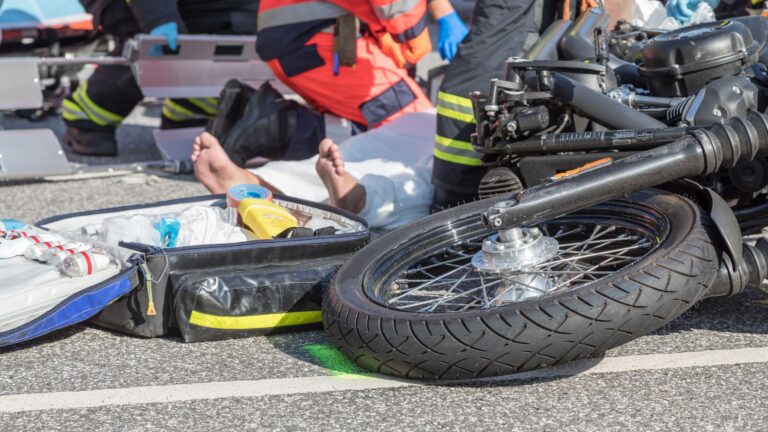
Around 6,200 motorcycle fatalities occurred in the U.S in 2024. Unlike car accidents, motorcycle crashes are fatal. Data from the Insurance Information Institute shows that motorcycle riders were 27 times more likely to die in an accident than those in passenger vehicles.
Aside from the life-threatening risks motorcyclists face on the road, they also face unfair bias. Most drivers assume bikers are at fault for motorcycle accidents.
Is this true? Are they truly responsible? Who is at fault in a motorcycle accident? And how is fault determined?
Keep reading to find out.
What Does “Fault” Mean in a Motorcycle Accident
Put simply, fault in a motorcycle accident means who caused the accident—whose action (or inaction) led to the crash. Whoever is at fault will be responsible for the damages incurred by the injured party—medical expenses, lost wages, property damage, and so on.
In cases like motorcycle accidents, fault is usually based on negligence. What’s negligence? It’s when someone fails to exercise the level of care that a reasonable person would have exercised in a similar situation.
Common examples of negligence are:
- Texting while driving
- Speeding
- Running a red light
- Aggressive driving
- Road rage
- Driving under the influence
If any of these reckless behaviors lead to a motorcycle accident, the negligent party may be required to cover all or some of the losses incurred due to the crash.
Here’s the thing: Determining fault isn’t as simple as adding 1 plus 1. For instance, two parties may be responsible for a crash. In such a case, evidence (traffic camera footage, police report, witness statements, etc.) will be examined to understand what truly happened.
How is Fault Determined?
Fault in a motorcycle accident isn’t determined by speculation or word of mouth—it’s determined by available evidence. This includes police reports, photographs, witness statements, and physical evidence.
These pieces of evidence play a crucial part in answering 2 questions:
1. How did the crash happen?
2. Who acted negligently?
When determining fault, a police report is often the first piece of evidence insurance companies and attorneys analyze. This is because it contains findings made by the responding officer, including statements of involved parties.
Road conditions, traffic signs, skid marks, and other accident-scene evidence can also provide clues about how the crash happened.
Then there are photos and videos of the accident scene. This visual evidence is crucial, as it helps insurance companies and attorneys reconstruct the sequence of events.
In complex cases, an accident reconstruction expert may be invited to examine the evidence and piece together how the crash happened. Their findings can help establish who is at fault.
Common Causes of Motorcycle Accidents That May Establish Fault
Not all motorcycle accidents are caused by the rider’s negligence. According to a Landmark Hurt report commissioned by the National Highway Traffic Safety Administration, in about 66% of multi-vehicle motorcycle accidents, the driver of the other vehicle caused the crash by violating the motorcyclist’s right of way.
Understanding the cause of a motorcycle accident can help establish the at-fault party.
Common causes are:
- Speeding
- Failure to yield
- Distracted driving
- Unsafe lane changes
- Running red lights or stop signs
- Poor road maintenance or hazards
- Driving under the influence
The cause of the accident, along with supporting evidence, can help establish the at-fault party who’d be legally responsible for damages caused.
Who Can Be Held Liable Aside from Another Driver
Sometimes, fault may not rest entirely on another driver. Other parties may be at fault depending on the circumstances. For instance, if potholes, missing traffic signs, or raised manhole covers contributed to the crash, the government agent responsible for maintaining the road may be held liable.
Of course, motorcycle manufacturers can also be held liable, especially if a design or manufacturing flaw contributed to the accident.
Parts manufacturers aren’t left out either. If a defective item contributed to the crash, they may be liable. Commercial vehicle employers and other parties, such as repair shops, maintenance providers, and contractors, may also share responsibility.
What Should You Do if Fault is Disputed?
It’s normal for the parties involved to disagree over who is at fault. In such a situation, what do you do? First, don’t admit fault. Additionally, avoid making statements that may be interpreted as you admitting responsibility for the crash.
Next, keep all evidence related to the crash, including photos of the accident scene, medical records, repair estimates, and so on. This evidence will be instrumental should the claim be challenged by the insurance company or in court.
You should also alert your insurer. Provide them with accurate information about the accident. If the dispute seems like something you can’t handle, contact Shaheen & Gordon, P.A.. They can help protect your rights, help gather stronger evidence to strengthen your claim, and speak to the insurance company on your behalf.
Can More Than One Person Be at Fault?
In some bike accidents, more than one person can be held liable for the crash. It’s commonly known as shared fault, where each party played a role in the accident. As a result, many states adopt a comparative negligence rule, while a few apply a contributory negligence rule.
For instance, if you are partly responsible for a crash in a State that follows the comparative negligence rule, you are entitled to compensation. However, your payout may be reduced by your level of involvement in the crash. The contributory negligence rule is stricter, as it limits or stops an injured plaintiff from recovering compensation if their actions contributed to the crash.
Final Thoughts
Determining fault in a motorcycle accident can be complicated. As a result, insurance companies turn to evidence to determine the at-fault party. They analyze photographs of the accident scene, police reports, video evidence, and witness statements to determine liability.
Keep in mind that sometimes, more than one party can be at fault. Motorcycle manufacturers, part manufacturers, and government agencies can also share fault. Make sure you contact a reputable attorney if a dispute arises.