

The myth of the self-made entrepreneur is powerful, but it is largely fiction. Behind nearly every thriving business owner is a web of guidance, hard-won wisdom, and strategic relationships. For Black women building enterprises from the ground up, mentorship is not a luxury or a soft skill. It is one of the most powerful tools available for breaking through barriers, accelerating growth, and sustaining success in markets that were not always designed with you in mind. This article breaks down what mentorship truly is, why it matters deeply for Black women entrepreneurs, and exactly how to build the kind of mentorship network that fuels multimillion-dollar ambitions.
What mentorship really means in entrepreneurship
With the importance of support established, let’s clarify exactly what mentorship is and what it is not.
Mentorship is a strategic relationship where a more experienced person (or peer) provides guidance, knowledge, and support to help someone grow. In entrepreneurship, that means more than swapping business cards at a networking event. It means consistent, intentional connection that builds your skills, sharpens your thinking, and strengthens your resilience over time.
There are several distinct forms mentorship can take, and understanding each one helps you choose the right fit for your stage of business:
- One-on-one mentorship: A dedicated relationship between you and a single mentor, typically someone more experienced in your industry or field.
- Group mentorship: A structured setting where one mentor works with several mentees simultaneously, creating a community of shared learning.
- Peer mentorship: Relationships between entrepreneurs at similar stages, where both parties exchange insights and accountability.
- Reverse mentorship: A younger or less experienced person mentors a senior one, often sharing fresh perspectives on technology, culture, or emerging markets.
Research confirms that these relationships are not just feel-good connections. Mentorship enhances cognitive, leadership, and business management skills, as well as resilience and business stability for female entrepreneurs, with individual and group formats each producing different but measurable outcomes. That means choosing the right format matters as much as choosing the right mentor.
| Mentorship type | Primary benefit | Best for |
|---|---|---|
| One-on-one | Personalized, deep guidance | Founders in early or pivot stages |
| Group | Diverse perspectives, community | Scaling entrepreneurs |
| Peer | Mutual accountability | Entrepreneurs at similar stages |
| Reverse | Fresh insight, innovation | Established leaders seeking growth |
Understanding your own needs at any given moment is the first step toward choosing the right type of mentorship. And as your business evolves, your mentorship needs will evolve too. How you connect cultural identity and entrepreneurship shapes the kind of mentors you seek and the conversations that will actually move you forward.
“Mentorship is not a transaction. It is a relationship built on trust, shared purpose, and a genuine investment in someone else’s growth.”
Why mentorship is vital for Black women entrepreneurs
Now that mentorship is defined, let’s dig into why it makes a life-changing difference for Black women in entrepreneurship.
Black women are the fastest-growing group of entrepreneurs in the United States. Yet they still face a set of obstacles that are both systemic and deeply personal. Access to capital remains significantly limited compared to white male peers. Isolation in predominantly white or male industries is common. And the psychological weight of navigating systemic bias while building a business can be exhausting.

Effective mentorship addresses all of these challenges. Research on Black women and mentorship outcomes shows that for Black women, effective mentorship provides critical professional development alongside personal and race-specific support. Crucially, matching mentors by race, gender, or lived experience significantly improves satisfaction and outcomes. Ineffective mentorship, on the other hand, can actually make existing barriers worse.
Here is what high-quality mentorship can specifically offer Black women entrepreneurs:
- Professional development: Practical skills, industry knowledge, and strategic thinking that accelerate business growth.
- Race and gender-affirming support: A safe space to process the unique challenges of being a Black woman in business without minimizing or dismissing those experiences.
- Countering imposter syndrome: Regular affirmation from someone who has walked a similar path and can remind you that you belong in every room you enter.
- Network access: Introductions to investors, collaborators, and communities that might otherwise remain out of reach.
- Accountability: A consistent relationship that keeps you focused on goals and honest about progress.
The mental health challenges that Black women carry into their entrepreneurial journeys are real. Mentorship does not replace therapy or self-care, but it does provide a form of professional and emotional anchoring that is genuinely hard to replicate elsewhere. Similarly, the way self-image in entrepreneurship shapes your decisions, your pricing, and your confidence is something a well-matched mentor can help you examine and strengthen over time.
Pro Tip: When possible, seek mentors who share or deeply understand your lived experiences as a Black woman. Shared context is not just comforting. It is strategically valuable because it removes the need to constantly explain or justify your reality before getting to the actual business advice.
Building the right mentorship network: Strategies and structures
Understanding the impact, the next step is knowing how to assemble an effective mentorship structure tailored to your needs.
The most successful Black women entrepreneurs rarely rely on a single mentor. They build layered networks that include senior advisors, industry-specific guides, peer collaborators, and even junior voices who keep them sharp and current. This is not about collecting contacts. It is about building a deliberate ecosystem of support.
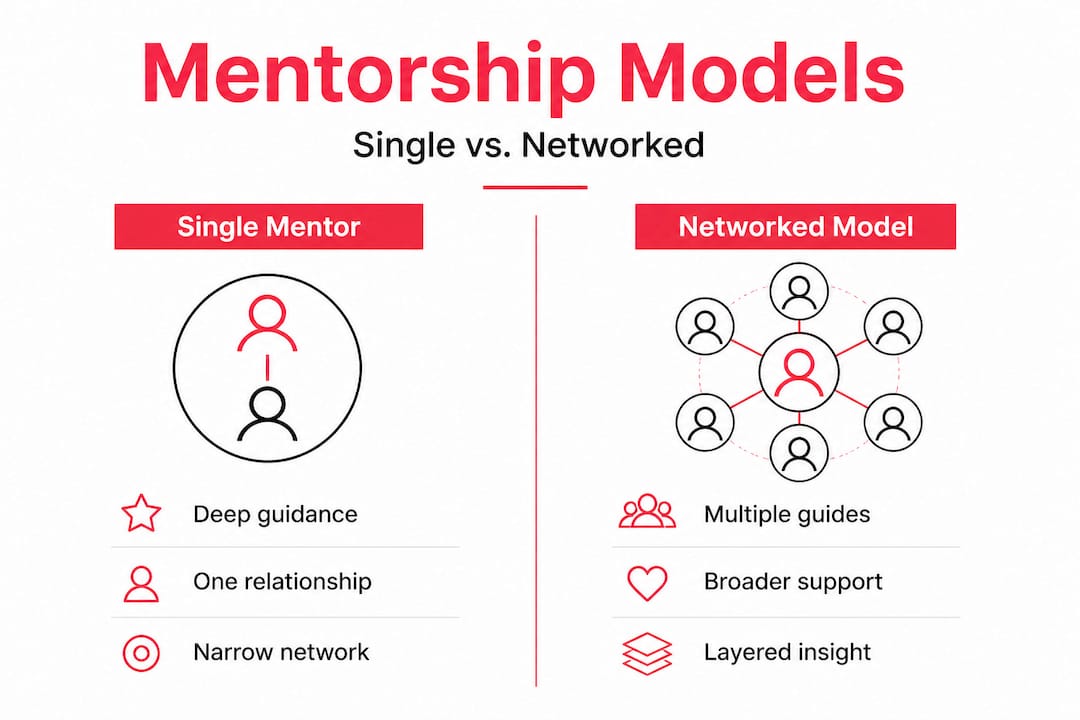
Layered mentorship networks with diverse mentors, including reverse mentorship, build meaningful social capital for Black women entrepreneurs. Social capital, meaning the value created through trusted relationships and networks, is one of the most powerful currencies in business. And for Black women who have historically been excluded from legacy networks, building it intentionally is essential.
Here is a practical five-step approach to building your mentorship network:
- Audit your current gaps. Identify where you need the most guidance right now. Is it financial strategy? Marketing? Leadership? Knowing your gaps helps you recruit the right people.
- Map your existing relationships. You likely already have people in your orbit who could serve as mentors or peer mentors. Start there before looking externally.
- Seek diversity in your network. Aim for mentors across industries, generations, and backgrounds. A mentor who built a tech company thinks differently from one who scaled a retail brand, and both perspectives are valuable.
- Formalize the relationship. Set clear expectations, meeting cadences, and goals. A mentor relationship without structure tends to fade. Treat it like a business partnership.
- Give back from day one. Even as a mentee, bring value. Share articles, make introductions, offer your own skills. Reciprocity builds lasting relationships.
| Factor | Single mentor model | Networked mentorship model |
|---|---|---|
| Depth of guidance | High | Moderate per mentor, high overall |
| Diversity of insight | Limited | Broad and varied |
| Risk of mismatch | High | Lower, with alternatives available |
| Social capital built | Narrow | Expansive |
| Adaptability as business grows | Limited | Highly adaptable |
Strong community building approaches are at the heart of this model. When you invest in building community alongside mentorship, you create a support system that sustains you through the inevitable hard seasons of entrepreneurship. Tapping into social capital strategies that center your community means your network grows in ways that are both personally meaningful and professionally powerful.
Pro Tip: Do not overlook nontraditional mentors. Peers who are one step ahead of you, mentees who challenge your thinking, and even competitors who inspire you all have something to teach. Wisdom does not only flow downward from senior to junior. It moves in every direction.
Overcoming mentorship challenges and common pitfalls
With a strategy for building your network, it is just as important to understand potential obstacles and how to address them early.
Not every mentorship is a good fit. And a mismatched mentor relationship can actually slow you down rather than accelerate your growth. The key is recognizing the warning signs early and knowing exactly what to do when things are not working.
Common red flags in a mentorship relationship include:
- Lack of commitment: A mentor who consistently cancels, arrives unprepared, or gives vague advice is not investing in your growth.
- Poor boundary-setting: A relationship where expectations are unclear often leads to frustration on both sides.
- Failure to provide affirming support: If your mentor dismisses or minimizes the race and gender-specific challenges you face, that gap will limit how much you can actually grow together.
- One-directional communication: Healthy mentorship involves listening as much as advising. A mentor who only talks and never asks questions is missing a crucial piece.
- Misaligned values or goals: If your mentor’s vision of success looks nothing like yours, their advice may consistently pull you in the wrong direction.
Ineffective mentorship exacerbates barriers and deepens imposter syndrome for Black women, making it more important than ever to address problems in a mentorship relationship quickly rather than quietly tolerating them.
“An ineffective mentor does not just fail to help. They can actively reinforce the very doubts and obstacles you are trying to overcome.”
If your mentorship is not working, here is what to do:
- Have an honest conversation about what is and is not working. Most good mentors will appreciate the directness.
- Revisit your goals together and renegotiate the terms of the relationship if needed.
- Seek feedback from peers or other mentors about whether the issues you are experiencing are common.
- If the relationship cannot be repaired, it is okay to move on. Protecting your time, energy, and momentum is not disrespectful. It is strategic.
Navigating self-doubt is already hard enough without a mentor who makes it worse. You deserve relationships that build you up, challenge you constructively, and reflect your full humanity back to you.
A fresh perspective: What most advice about mentorship misses
With the formal aspects covered, let’s challenge some of the dominant narratives with a real-world perspective.
Most mainstream mentorship advice is built around a simple transactional model: find someone powerful, impress them, and hope they open doors for you. That model was designed for a specific type of professional, in a specific type of industry, with a specific set of advantages. It was not designed with Black women in mind.
For Black women entrepreneurs, the most transformative mentorship relationships are not transactional. They are rooted in shared values, mutual respect, and a genuine willingness to challenge each other’s thinking. The best mentor you will ever have is not necessarily the most famous or the most connected. They are the person who sees your full potential, tells you the truth when you need to hear it, and walks alongside you through the messy middle of building something real.
There is also a piece of the mentorship conversation that rarely gets enough attention: the power of becoming a mentor yourself. Many Black women wait until they feel “successful enough” to mentor others. But mentoring someone earlier in their journey is one of the fastest ways to clarify your own thinking, strengthen your leadership, and build the kind of community that sustains you long-term. Mentorship is a two-way street, and the growth flows in both directions.
Navigating nontraditional paths is something Black women entrepreneurs do every single day. The mentorship model that serves you best will likely look nontraditional too. It might be a group of peers who hold each other accountable every week. It might be a senior advisor in a completely different industry who helps you think bigger. It might be a younger entrepreneur whose energy and innovation push you to evolve.
Pro Tip: Do not wait for the perfect mentor to find you. Initiate reciprocal relationships, seek wisdom across generations, and recognize that every meaningful connection you build is a form of mentorship. The most powerful networks are built by people who give generously and ask boldly.
Your next steps: Community, resources, and mentorship support
Ready to take the next step? Here is how you can move your entrepreneurial journey forward with mentorship and the power of community.
Building a business as a Black woman takes more than strategy. It takes a community that sees you, supports you, and pushes you to reach higher. BAUCE was built exactly for that purpose.
At BAUCE, you will find a rich hub of resources tailored specifically for Black women entrepreneurs, from success stories and business strategy guides to personal development tools and community connections. Whether you are just starting out or scaling toward your next million, the platform offers the kind of mentorship-aligned content that keeps you informed, inspired, and equipped to act. Take action in your career by connecting with communities, exploring mentorship programs, and surrounding yourself with women who are building boldly, just like you.
Frequently asked questions
How can I find a mentor who understands my experiences as a Black woman entrepreneur?
Seek local business organizations, alumni groups, industry coalitions, or communities like BAUCE where you can connect with mentors who prioritize race and gender understanding. Race and gender matching consistently improves mentorship outcomes and satisfaction for Black women.
What should I do if a mentor relationship is not working for me?
Be honest, seek feedback, attempt to rebalance goals, and if misalignment persists, consider finding a mentor who offers better fit and support. Ineffective mentorship can deepen imposter syndrome, so addressing the issue quickly protects your growth.
Is group mentorship as effective as one-on-one mentoring?
Both approaches offer real benefits. Individual mentoring provides tailored, personalized advice, while group formats foster diverse perspectives and community. Research shows individual vs. group formats yield different outcomes, so combining both is the strongest approach.
Can peer mentorship be valuable for business growth?
Absolutely. Peer mentorship builds reciprocal support, mutual accountability, and expands your social capital in meaningful ways. Diverse mentorship networks that include peers are especially powerful for Black women entrepreneurs building lasting enterprises.
What are signs of a high-impact mentor relationship?
Look for open communication, cultural affirmation, mutual respect, and measurable business or personal growth over time. Effective mentorship enhances skills, resilience, and business stability for female entrepreneurs, and you should feel those improvements clearly.